Scenario orchestration
Version mission geometry, roles, constraints, seeds, and environmental assumptions as one controlled definition.
Simulation and trade studies
A working synthetic 3D browser demonstration of 425 agents: 75 Raven drones in three cohorts and 350 red drones in sphere, cube, and triangle formations, with replayable network conditions and geographic imagery as a visual reference.
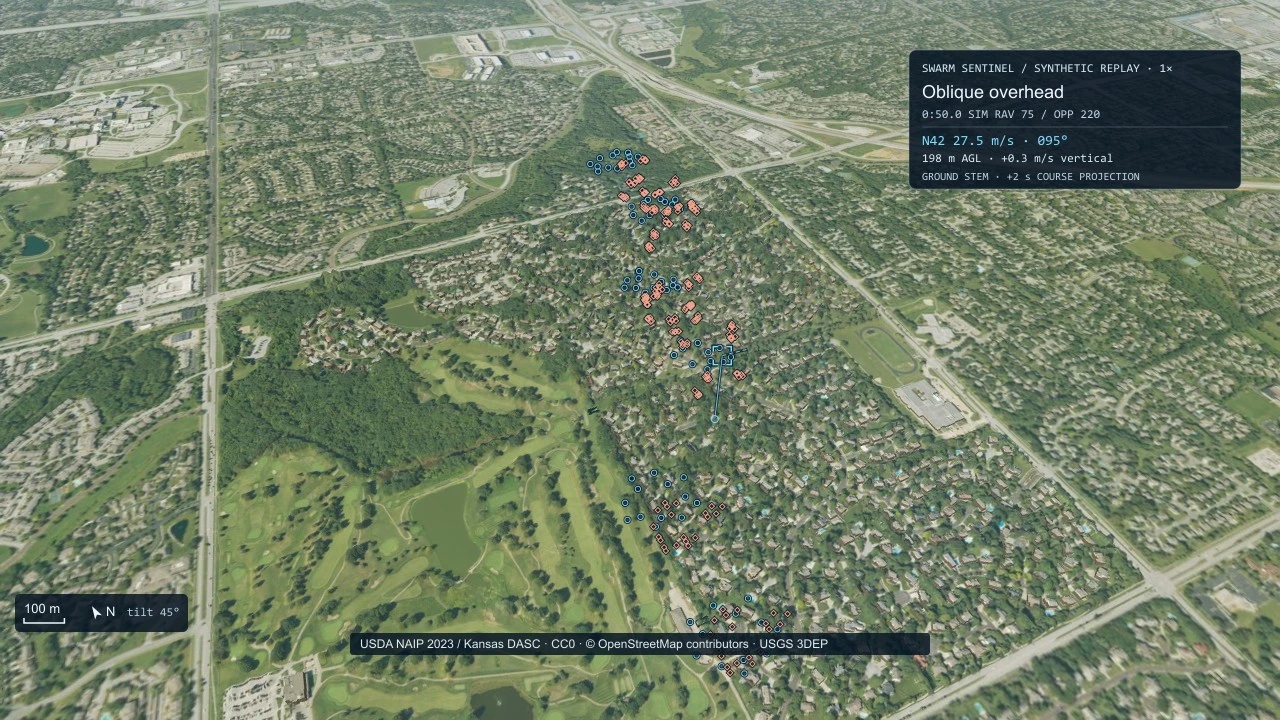
Which autonomy approach remains explainable and useful as mission, network, and node conditions change? RAV SwarmSim is Raven’s software research and evaluation environment. The public demonstration keeps scenario configuration, communications conditions, events, and replay records together so visitors can inspect how a simulation changes over time. The area viewer adds open geographic data for exploring terrain and neighborhoods.
Working synthetic demonstration. No government sponsor, award, contract, measured result, or operational deployment is represented.
RAV is Raven Development Operations' internal working label, not a government program name, sponsor designation, fielded system, or readiness claim.
Public, unclassified overview only. Do not submit classified information, CUI, export-controlled data, source-selection information, or proprietary interface details through this website.
Would support software-first feasibility analysis before a program commits to aircraft, radios, sensors, or other platform-specific integrations.
The working SwarmSim demonstration keeps scenario inputs, communications conditions, and synthetic output separate so visitors can see what caused each event. These responsibilities describe the software package Raven can own for this research direction.
Version mission geometry, roles, constraints, seeds, and environmental assumptions as one controlled definition.
Exercise multiple compatible approaches against the same conditions without changing the evaluation frame.
Introduce controlled latency, loss, partitions, and node availability changes to expose brittle behavior.
Keep configuration, observations, measure definitions, and unresolved risks attached to each run set.
Choose from seven scenarios. The featured 60-second fictional replay has 425 model agents. Red waves enter at 15-second offsets: A1 has a 50-node sphere and 100-node cube; B1 has a 100-node sphere and 50-node cube; C1 has two 25-node triangles. Three Raven cohorts of 25 emerge from A2, B2, and C2 in flowing spiral groups. The animated formations continue toward A3, B3, and C3 while sustained visual pulses accompany scripted disappearance and regrouping into smaller formations. Geographic imagery is a visual reference only. Scene actor counts are separate from the synthetic network model. Change latency and packet loss, simulate node outages and recovery, and replay every intervention. Download the run JSON and CSV for network diagnostics, or the companion scene JSON for camera shots and authored visual cues.
The useful deliverable is a versioned experiment record that preserves configuration, observation context, outliers, and unresolved risk.
Choose a preset, then set the seed, node count, delay, packet loss, and unavailable node within the displayed ranges. Output: Synthetic scenario configuration
Execute the deterministic model from the recorded configuration and preserve its run identity. Output: Versioned deterministic run
Inspect the animated topology, timestamped events, and clearly labeled synthetic summary counts. Output: Synthetic event and summary comparison
Download the run configuration and event sequence in portable formats. Output: rav-swarmsim-run/v1 JSON manifest and CSV trace
Working synthetic demonstration · deterministic browser output.
Working export · generated after a completed synthetic run
Each completed run produces a JSON manifest and CSV event trace from the same deterministic synthetic result.
The files describe a browser-based synthetic coordination run. They do not represent operational autonomy, field testing, or measured system performance.
These materials distinguish the public project state from work that depends on a funded partner effort.
Available on this page. 75 Raven agents in three cohorts of 25 and 350 red agents across six formations. Waves enter at 15-second offsets, followed by spiral deployments from A2, B2, and C2. Continuous motion, sustained visual pulses, and smaller regrouped formations share one 60-second timeline. What it shows: The public interface executes and replays the same deterministic 3D browser model from a recorded configuration.
Generated from each completed run. A rav-swarmsim-run/v1 JSON manifest captures the engine version, run identity, inputs, and synthetic summary counts. A CSV file carries the timestamped event trace. What it shows: Another person can inspect the exact synthetic inputs and event sequence produced by the browser demonstration.
Partner-gated. Would add approved scenarios, candidate adapters, program measures, run authority, and controlled observations. What it shows: Program conclusions require partner-approved inputs and evaluation beyond this public synthetic demonstration.
The candidate enters through an agreed adapter. Scenario inputs and run outputs remain versioned around it so an evaluation can be repeated or challenged.
Pin mission geometry, roles, constraints, seeds, and communications assumptions.
Use an agreed software interface without changing the surrounding evaluation frame.
Vary network and node conditions while preserving the decision question.
Retain traces, observations, configuration, and open risks for comparison.
A focused effort starts with one mission question, compatible candidate interfaces, controlled conditions, and named owners for the run package. Would support software-first feasibility analysis before a program commits to aircraft, radios, sensors, or other platform-specific integrations. Raven can own: Deterministic synthetic browser demo, run controls, animated topology, timestamped trace, and rav-swarmsim-run/v1 JSON and CSV exports. Partner supplies: Mission question, approved candidate interfaces, evaluation assumptions, measures, data-handling rules, and test authority. Closeout decision: A documented decision to stop, revise, or advance one candidate with open risk carried forward.